
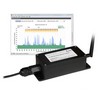
AvaLAN Wireless Spectrum Analyzers
Wireless spectrum analyzers provide accurate monitoring and analysis of RF signals across defined frequency ranges enabling efficient identification of signal behavior and interference in wireless environments. Supporting frequency tuning range from 2385 MHz to 2498 MHz with channel bandwidth configured at 1 MHz increments enabling detailed spectrum analysis, these analyzers are intended for applications requiring precise frequency scanning and signal measurement. Designed for outdoor mounting operating -40 to 70 degrees Celsius with power sensitivity of -97 dBm detecting low-level signals and 5 dB antenna gain enhancing signal reception.
For comprehensive AvaLAN wireless solutions beyond spectrum analyzers, explore our AvaLAN Wireless Ethernet Radios, Bridges, Gateways, Modules & Analyzers category, featuring 900 MHz, 2.4 GHz, 4.9 GHz, 5 GHz wireless bridges, Ethernet radios, 4G cellular gateways, and OEM RF modules for industrial wireless networking.
Related Categories:
- AvaLAN Wireless 900 MHz Ethernet Radios and Wireless Bridges
- AvaLAN Wireless 2.4 GHz Ethernet Radios and Wireless Bridges
- AvaLAN Wireless High Security Wireless Ethernet Radios
- AvaLAN Wireless 4G Cellular Ethernet Gateway
- AvaLAN Wireless OEM RF Modules
FAQs
What are wireless spectrum analyzers used for in RF environments?
Wireless spectrum analyzers are designed to provide accurate monitoring and analysis of RF signals across defined frequency ranges enabling efficient identification of signal behavior and interference in wireless environments. These analyzers support applications requiring precise frequency scanning and signal measurement allowing improved visibility into network performance and spectrum utilization. Applications include professional environments requiring continuous RF monitoring, wireless network diagnostics, interference detection, and optimization of wireless systems.
What frequency range do wireless spectrum analyzers support?
Wireless spectrum analyzers support frequency tuning range from 2385 MHz to 2498 MHz with channel bandwidth configured at 1 MHz increments enabling detailed spectrum analysis. The 1 MHz bandwidth increments enable precise frequency scanning across the supported range for accurate signal measurement in professional wireless environments.
What power sensitivity enables low-level signal detection in spectrum analyzers?
Wireless spectrum analyzers provide power sensitivity of -97 dBm to detect low-level signals enabling identification of weak RF sources and interference in wireless environments. The -97 dBm sensitivity supports detection of distant transmitters, spurious emissions, and background noise requiring accurate monitoring. High sensitivity combined with 5 dB antenna gain enhances signal reception supporting reliable spectrum analysis in professional RF monitoring applications.
What operating temperature range supports outdoor deployment in Wireless spectrum analyzers?
Wireless spectrum analyzers are designed for outdoor mounting with operating temperature range specified from -40 degrees Celsius to 70 degrees Celsius ensuring reliable functionality across varying environmental conditions. The -40°C to 70°C range accommodates outdoor professional environments experiencing extreme temperature variations. Temperature capability combined with outdoor mounting design supports continuous RF monitoring and analysis in harsh environmental conditions.
What are the physical dimensions of wireless spectrum analyzers?
Wireless spectrum analyzers feature unit dimensions defined with length of 7.87 inches, width of 3.15 inches, and height of 2.28 inches while weight of 1.26 lbs is maintained for manageable deployment. The compact 7.87 x 3.15 x 2.28 inch dimensions support installation in space-constrained outdoor locations. Lightweight 1.26 lb construction facilitates mounting in professional wireless monitoring installations requiring portable or permanent spectrum analysis equipment.
What power requirements do wireless spectrum analyzers need?
Wireless spectrum analyzers are designed to operate using 12 Vdc power supply ensuring stable performance during operation in continuous RF monitoring applications. The 12 Vdc requirement accommodates standard power sources used in outdoor professional environments. Stable power delivery supports reliable spectrum analysis enabling accurate signal measurement and interference detection in wireless network diagnostics applications.
How does antenna gain enhance wireless spectrum analyzer performance?
Wireless spectrum analyzers utilize antenna gain of 5 dB to enhance signal reception improving detection of RF signals in professional monitoring environments. The 5 dB gain increases effective sensitivity beyond base -97 dBm level supporting detection of weaker signals. Enhanced signal reception combined with controlled bandwidth and structured data visualization ensures consistent performance in environments requiring reliable spectrum analysis and wireless system optimization.
Need assistance selecting the right wireless spectrum analyzers for your RF monitoring, interference detection, or wireless network optimization application? Our engineering team provides expert technical guidance on frequency range requirements, sensitivity specifications, outdoor mounting considerations, and spectrum analysis capabilities for your specific professional wireless monitoring, network diagnostics, or RF interference detection application requirements.
Contact Sales: Sales@L-com.com
Product Technical Support: techsupportrf@infiniteelectronics.com
L-com wireless spectrum analyzers are part of over one million RF, microwave, and millimeter wave components in stock for local, domestic, and international shipment.